

RESEARCH
Energy Transition and CCS
Anthropogenic CO₂ emissions have driven a sharp rise in greenhouse gas concentrations, leading to global warming and ocean acidification. Reducing current and future emissions is therefore unavoidable.
Chiang Mai CCS
Thailand has pledged to achieve net-zero greenhouse gas emissions by 2065 — a commitment announced at COP26 and reaffirmed in its long-term strategy at COP27.
Thailand has pledged to achieve net-zero greenhouse gas emissions by 2065
—a commitment announced at COP26 and reaffirmed in its long-term strategy at COP27.

Chiang Mai University aligns with this vision through its 13th Educational Development Plan, which integrates the UN Sustainable Development Goals (SDGs). In the 2025 Times Higher Education Impact Rankings, CMU ranked 44th globally overall and 40th worldwide for SDG 13: Climate Action, reaffirming its position as a national leader in sustainability.


THE TRANSITION CHALLENGE
Rebuilding the energy system
Transitioning to net zero requires rebuilding much of the global and national energy system. The challenge lies in both energy supply and energy demand.
Supply
The shift from oil, gas, and coal to low-carbon sources such as solar, wind, hydro, and nuclear is underway. Yet fossil fuels still provide over 80% of global energy today, meaning emissions will continue during the transition. Interim solutions are needed to minimize the carbon footprint of these fuels.
Demand
Transport, buildings, and industry require new zero-carbon technologies. Electric vehicles and renewable electricity will play a major role, but heavy transport and aviation may rely on alternative fuels such as hydrogen. Expanding renewable generation and upgrading national power grids are equally critical.
Amid these challenges, Carbon Capture and Storage (CCS) is recognized in Thailand’s Long-Term Low Greenhouse Gas Emission Development Strategy (LT-LEDS) and related national action plans as a main mitigation pathway for the energy and industrial sectors. The Department of Climate Change and Environment (DCCE) drives policy development and advances implementation frameworks.
CCS, acknowledged globally by the IPCC, captures CO₂ from power plants and industrial facilities and stores it deep underground in saline aquifers or depleted hydrocarbon fields. This prevents emissions from entering the atmosphere while supporting national energy security. Furthermore, CCS enables negative emissions when combined with bioenergy (BECCS), providing one of the few viable options to offset residual emissions from hard-to-abate sectors such as cement and steel.
Chiang Mai CCS is committed to advancing solutions that support Thailand’s energy transition while strengthening national energy security. Our research program covers the full CCS value chain — from capture technologies and transport systems to subsurface storage and monitoring — with a particular focus on enhancing storage efficiency and ensuring safe, permanent containment. The key areas of this program are outlined below.
RESEARCH PROGRAM
Our Flagship Focus


WP1: Capture and Source Identification
We identify major concentrated CO₂ point sources across Thailand, including fossil-based power plants, cement plants, and other hard-to-abate industries. Accurate source characterization — volume, purity, and location — is critical to design capture systems and to match sources with potential storage sites.
Research also targets capture technologies, since capture costs typically represent the largest share of CCS project expenses. Our focus includes evaluating existing capture systems and developing innovations to lower costs while maintaining high efficiency, thereby improving CCS affordability.

WP2: Transport and Utilization
We optimize transportation options from sources to storage sites, applying AI-assisted modeling to design networks tailored to Thailand’s geography and industry clusters. Research investigates the most suitable CO₂ transport state — gas, liquid, or supercritical — depending on distance, pressure, and volume.
Where feasible, we also examine integrated CO₂ utilization pathways (e.g., in enhanced oil recovery or emerging CO₂-derived products) as potential means to partially offset CCS costs.

WP3: Physical Geological Storage
This WP emphasizes storage containment and integrity in target formations. We investigate CO₂ trapping mechanisms — structural and stratigraphic, residual, and solubility — and explore methods to enhance their effectiveness across pore, core, and field scales.
Activities include reservoir simulation, injection design, and well integrity assessment, all directed at ensuring secure and efficient long-term storage.

WP4: Geochemical Geological Storage (Mineralization)
Here, we focus on mineral trapping, where injected CO₂ reacts with reservoir minerals to form stable carbonates. We study both conventional sandstone and carbonate reservoirs and unconventional options such as basaltic formations, assessing their storage potential and identifying strategies to accelerate mineralization.

WP5: Storage Capacity Quantification
We perform regional to basin-scale geological assessments to identify and rank candidate storage sites. Using seismic surveys, well data, and numerical simulations, we estimate effective storage capacities and refine them toward site-specific scales. This work underpins long-term storage planning for Thailand’s key sedimentary basins.

WP6: Techno-economic Analysis and Incentives
Recognizing that CCS is a relatively high-cost mitigation option, we conduct techno-economic evaluations that reflect current technology, local conditions, and deployment pathways. We also analyze financing mechanisms — private, public, or hybrid models — and explore how policy incentives and carbon pricing could evolve to enable CCS deployment at scale.

WP7: Measurement, Monitoring, and Verification (MMV)
This WP ensures the secure and permanent storage of CO₂. We design MMV strategies using a combination of conventional seismic imaging, emerging fiber-optic sensing, geochemical monitoring, and pressure/tilt measurements. Our goal is to track plume migration over time, detect potential leakage, and establish protocols that can serve as regulatory benchmarks for CCS projects in Thailand.
IN SUPPORT OF THE UN SUSTAINABLE DEVELOPMENT GOALS (SDGs)
Three SDGs Most Relevant to Carbon Capture and Storage
Chiang Mai CCS contributes directly to the United Nations Sustainable Development Goals, focusing on three SDGs most relevant to carbon capture and storage.
 07
Affordable and Clean Energy
Energy security and affordability remain critical for Thailand and other ASEAN economies. Many energy sources in emerging economies are still fossil-based, and transitioning away from them will take time. By deploying CCS, these fuels — along with carbon-based renewables such as biomass — can be used more cleanly, with CO₂ captured instead of released. Our research ensures that CCS can serve as a bridge technology that supports energy security while reducing emissions.
 09
Industry, Innovation, and Infrastructure
CCS is more than a technology; it is an emerging green industry. Implementation of full-chain CCS requires large-scale infrastructure, new business models, and innovation across capture, transport, and storage. This will create opportunities for research, development, and employment throughout the value chain. Chiang Mai CCS supports this transition by advancing R&D, innovation, and knowledge transfer to strengthen Thailand’s role in the regional CCS economy.
 13
Climate Action
CCS is not just an option — it is a necessity. Limiting global warming requires gigaton-scale removal of CO₂ and other greenhouse gases. Few technologies are capable of delivering this at scale, and CCS is recognized globally, including in Thailand’s LT-LEDS, as a key mitigation pathway. Chiang Mai CCS dedicates its expertise and resources to developing safe, permanent, and scalable storage solutions, consolidating our role in national and regional climate action.


RESEARCH INFRASTRUCTURE
Key Research Facilities
In addition to shared access to Chiang Mai University facilities and national laboratories, Chiang Mai CCS is equipped with state-of-the-art facilities that directly support our research priorities in CO₂ storage and utilization.

High-pressure core-flooding setup for CO₂ storage
The first public research facility of its kind in Thailand, this setup enables experiments on CO₂ injection and storage under reservoir conditions. It allows investigation of storage capacity, geochemical interactions, and methods to improve trapping efficiency. Applications include studies on supercritical CO₂ behavior and CO₂-EOR processes.

Chiang Mai Sandtank
Our 2.5-dimensional sandtank is designed to replicate reservoir structures and enables direct observation of CO₂ plume flow and behavior during injection. This setup supports research into plume dynamics, trapping efficiency, and strategies to improve storage performance. Beyond research, the sandtank also serves as a demonstration tool to illustrate the security of CO₂ storage — a crucial element in building public confidence and stakeholder trust in CCS.

Optical Tensiometer with High-Speed Imaging
Interfacial phenomena are central to multiphase flow in porous media, including during CO₂ injection into deep formations. Our optical tensiometer, equipped with a high-speed camera, makes it possible to analyze interfacial tension and wettability dynamics across scales — from sub-pore interactions to core-scale processes.


Commercial Reservoir Simulators
Through generous contributions from industry partners such as SLB and Computer Modelling Group (CMG) Ltd., Chiang Mai CCS has access to the same commercial-grade reservoir simulators used in the field. This ensures our modeling and simulation studies are aligned with real-world industrial practice and directly comparable with both academic and industrial research worldwide.
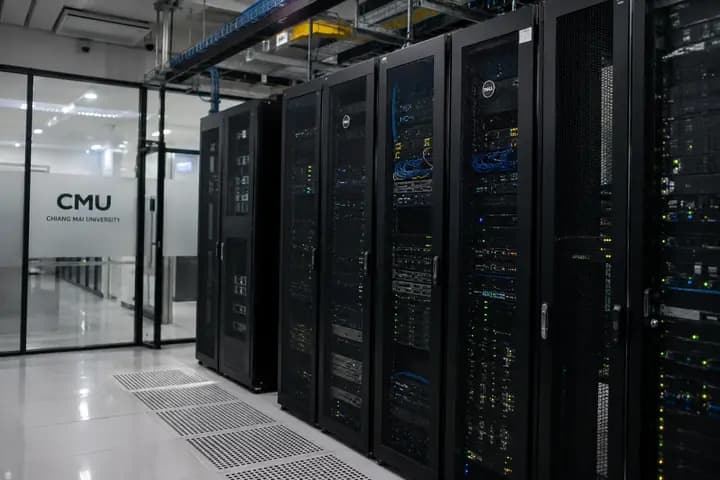
High-Performance Computing (HPC) Resources
Our dedicated servers and high-performance computing (HPC) clusters support large-scale reservoir simulations, machine learning applications, and deep learning models. These resources enable researchers to run complex models with reduced computation time, from reservoir-scale simulations to advanced georesources analytics, ensuring precision and efficiency in tackling demanding computational challenges.